Showing posts with label feminism. Show all posts

Tuesday, May 10, 2016

Barbie's New Look by Savana Joyeuse


Barbie has been an iconic doll since the 50's. She was brought to fame by her bright blonde hair, thin body, and robust chest. However, this image does not reflect the girls who play with her today. In fact, her "iconic" look is unrealistic for the average woman. If Barbie was real her proportions would be a 32F chest size and a 20 inch waist. Some women, like Valeria Lukyanova, known as "The Real Life Barbie", have tried to mimic these proportions for the ideal look.

Recently, large amounts of criticism have been directed toward Mattel (the Barbie doll manufacturing company). Critics state that girls shouldn't be surrounded by this unrealistic body image. In January 2016, a new line of more realistic Barbies were launched. She now has three new body types: tall, petite, and curvy. These new dolls come in a variety of skin tones and hair styles to reflect the women of today. 


Although the changes in Barbie are unique and more "realistic" the original Barbie will always hold a place in my heart. I believe there's no strong need for the new body types. Growing up playing with Barbies, I never felt pressure to match her image. I always knew it was just a doll; she's Barbie! Bringing countless hours of happiness to young girls since her creation, she should not change just because the year has. In the end you can change her hair, you can change her clothes, but I hope America finds their way back home to the classic Barbie. 


For more on Barbie's new look click here


Monday, May 9, 2016

Body Positivity by Brooke Matthews


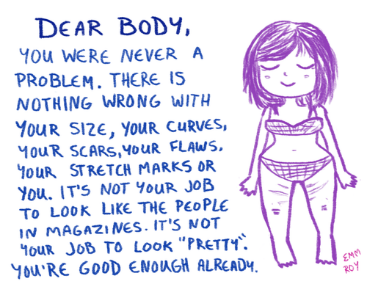
When you think about your favorite actors, actresses, singers, models, etc., how many plus-sized men and women come to mind? Chances are you can only think of a couple, or if you are like most people, probably none. The way plus-sized people, women especially, are portrayed in media is not the same as thinner-figured individuals are portrayed. Because of the way bigger women are shown in the media, women have begun to believe the term “plus-sized” or “fat” is bad. Thanks to the body positivity movement, however, we are showing women of all shapes and sizes that it is okay to love your body regardless of your size.


The film industry rarely casts full-figured women in lead roles, and if they do, she serves as comedic relief; take, for example, Fat Amy. Other times she is hidden amongst the crowd. We also see them portrayed as the “ugly duckling” who usually overcomes obstacles caused because of her weight, and gets the man in the end, like in the movies Hairspray and Just Wright. Rarely is there a movie where a plus-sized woman’s weight isn’t the source of her lack of confidence, depression, or undesirability. Why can’t we cast more big women in leading roles? Are we shaping a negative belief in our society?

It is no doubt that the media sculpts the way we think about everyday life. Not only do movies outline the way adult women think, but it changes the way young girls see themselves. If a young girl is watching her favorite movies or TV shows and all of her favorite characters are tall and thin, the girl will begin to wonder why her body does not look that way. The fix is as simple as casting plus-sized girls to stop insecurity at a young age.

As an attempt to help this cause, women all over the world have started the body positivity movement. This movement acts to encourage girls to love their bodies no matter what color, how big,  how rough or scarred, or how different. The body positivity movement has brought women of all backgrounds and cultures together to grow and work as a team rather than against each other. Famous women have spoken on the topic, such as Demi Lovato, Mary Lambert, Rihanna, and Rebel Wilson, all saying that this movement has helped them cope with being a larger woman in media and is helping their sisters get the recognition they deserve.


Although body positivity isn’t supported by all, it has helped thousands of young women accept their bodies. As the movement continues to grow, the way plus-sized men and women are viewed will hopefully change. No longer will “fat” or “plus-sized” be an insult, and no longer will only “skinny” people take the leads in the media. The future of film should heavily rely on the reflection of reality. Plus-sized women embody the hues of womanhood and should be appreciated.


Visit here for more articles on body positivity!

Monday, May 2, 2016

Feminism in Music by Grace Hicks


Feminism can be defined as the belief that women should have equal opportunity as men politically, socially, and economically. It also embraces the belief that everyone should have equal civil rights no matter a person’s sexuality, race, ethnicity, religion, culture, or lifestyle. These beliefs are prevalent within the music industry. You can find many artists' feminist beliefs entwined in their songs as they use their influence to spread awareness of their views.

We all know that Beyoncé wears her feminist crown proudly. She showcases this in numerous ways, from having "FEMINIST" across her stage during her 2014 Ms. Carter Tour to her feminist anthems. It is also present in the introduction to her recent single, "Flawless," explained by Chimamanda Ngozi Adichie, the host of Ted Talk.  She told ELLE her reasoning behind this introduction is to clarify the meaning of feminism. The introduction also brings up multiple different societal expectations between genders. "We teach girls that they cannot be sexual beings the way boys are." This addresses the double standard that when girls act sexually or are not covered enough, it is portrayed as a bad thing. When men wear minimal clothing no one sees it as problematic. In the chorus of this song it says "Ladies, tell ‘em I woke up like this. I woke up like this. We flawless." This portrays her belief that women can wake up and be flawless, and that it is not necessary for women to spend copious amounts of time getting ready to be socially acceptable. In another one of Beyoncé’s singles, "We Run the World," she assures her audience that feminism is for men as well. "To the men who respect what I do, please accept my shine."

Miley Cyrus is another feminist influence in pop culture. At the 2013 Video Music Awards she had a controversial performance, which consisted of revealing clothing and sexual dance moves. All of this, especially after she had recently gotten a haircut that is considered masculine, was blown out of proportion. Cyrus was hit with a wave of disapproval because people thought that the purpose of her performance was to attract more males to her fan base. However, she didn’t let this hate get her down. Cyrus responded, saying that just because she was acting in a particular manner does not mean she was exploiting her sexuality. Miley has helped make great leaps for everyone by saying that "Genders aren’t the problem, stereotypes are."

Madonna is another feminist influence in music. Throughout her entire career both her songs and music videos have pushed the limits of women’s sexuality. Her explicit videos and lyrics promotes women’s sexuality. Her video "Justify My Love" was explicit and was nicknamed a "celebration of sex," claiming that sexuality isn’t just for men, but for women as well.

The definition of humanism is an outlook or system of attaching prime importance to humans rather than divine or supernatural matter. Humanists focus on the goodness of a human being above anything else. Humanists relate to feminists because both groups believe all humans should be equal and important. All of these artists share the same beliefs that by being a feminist, it makes you a humanist as well.

Kurt Cobain, member of Nirvana, was an avid male feminist who detested gender inequality. He once wore a dress in his music video and to an interview in Los Angeles. In an interview he said, “Wearing a dress shows I can be as feminine as I want.” He broke the stereotype that men wearing dresses was unacceptable. He also said, “I have nothing against heavy metal, except that it can be pretty sexist.” This was a big deal during the time because a male band member as influential as Cobain claiming his distaste for aspects of his own music genre was not typical.

There are also other male feminists like John Legend, John Lennon, Harry Styles, and Eddie Vedder. John Legend preformed a charity concert with Beyoncé and Florence and The Machine for Chime for Change, an organization that puts funding towards bettering women’s lives all across the world. John Lennon played a large role in shifting gender roles in the 1980s. He was one of the only artist at the time to integrate feminist ideas, masculinity, and relationships into his work. Harry Styles, a member of One Direction, is a supporter of the #HeforShe campaign. The #HeforShe campaign encourages boys to fight for gender equality.  He tweets his support and encourages others to do so as well. Eddie Vedder, member of Pearl Jam, has played in Rock for Choice, which is a pro-choice benefit, in the early ‘90s. When he was in the May 1994 edition of the Rolling Stones magazine he spread his beliefs, saying, “I’m usually good at controlling my temper, but all these men trying to control women’s bodies are really making me angry."


Many past and present music artists are making waves for feminism and its beliefs. The influence that these artists have on us helps empower and guide listeners to strive for equality. Every little step they take makes a difference, and that difference is much appreciated.    

Repeat My Name: The Female Protagonists of Today's Stories by Kayley Boddy


With the latest feminism craze on the rise, it's not surprising to see our YA books and blockbuster films sporting fresh-faced teenage girls as the protagonists. In the last four years, movies and novels such as The Hunger Games, Divergent and The Mortal Instruments have all bought into the female protagonist genre. It's actually what we've come to expect- a shy, small-town girl, caught up in a love triangle, suddenly faced with a war or an apocalypse and being turned into a fighter. And while our books and our films have delved into this female spotlight and shown us that females can be strong too, we're still missing something. We've forgotten how to make our characters diverse. We've instead turned our potentially multi-layered female protagonists into bland, stereotypical, worn-out heroes. Where did the originality go?


Think of it this way: out of every story with a female protagonist you've heard of in the past few years, it's more than likely that they all seem to be speaking the same message, in the same way. They live in the same situations: they come from a small town, they're shy, they have low self-confidence, and they're even white (which, of course, is another issue). Bonus points if there's a love triangle or if they're fighting for a boy they're in love with: Katniss Everdeen had Gale and Peeta, Tris Prior had Four, Cassie Sullivan had Ben and Evan, Sadie Kane had Anubis and Walt. Even Princess Leia had her trip-ups in the realm of love, with Luke and Han. Usually, they all possess the same flaws and actions as well. Hermione Granger, Katniss, and Bella Swan flirted to obtain what they desired. Cassie and Tris fight to keep their families together as their worlds tumble down around them. The closest of all female protagonists seem to be Katniss and Tris: both rebel against their governments for freedom. All of these characters live in a half-life, not yet fully complex and human, but only the shell of a fleshed-out character on a page. It seems to be that our mighty female protagonists are still being shaped into a stereotype we have developed in regards to our literature. Instead of Jane Eyre and Janie Starks, we're left with females from an English class character development sheet. And why do we do this?

The answer's simple. From our novels, we expect the characters we're familiar with, and therefore our writers build them accordingly and leave it at that. Nothing new is added because unfamiliarity doesn't sell novels. No new depths are added to our female protagonists because the only female protagonists we know are two-dimensional ones. We see shy, feminine characters because they reflect us, and we like being exposed to their strength because we feel as though we have that same strength inside us. We watch them fall in love amidst world crises because we hope we can find love amidst our own life crises. We were intrigued to see Tris Prior in such a fearless faction yet so weak around Four because it satisfied the craving we had for a strong female character; that satisfaction blinded us from the fact that the rest of her character is built upon a hopelessly-in-love stereotype. As long as writers include these few small traits that define the YA female protagonist, they satisfy our expectations. Females in our novels sell because they're simply female, and as long as they fit into the expectation we have for them, writers can neglect their full potentials. Our female protagonists are beginning to lack the character development and complexity they need because the only aspect readers are currently focused on is the fact that they are female.


We're missing the entire purpose of writing when we have these female protagonists. Nowadays, novels compete for the most dramatic love triangle or the most fragile-yet-unbreakable character. They compete to sell, and they sell by advertising females on their front covers; YA readers devour female protagonists because they play into the equal-representation-of-women-in-novels idea we work for. And the saddest part about it is that it's working. Why is it that in a time where females are being pushed to have the same complexity and ability as men, their representation in writing is still weak and worn out? And what does that say about our true ambitions? We're missing our female protagonists; we're receiving sugarcoated female stereotypes.


I cannot say that female protagonists in novels have always been this way, however, and I cannot say that I haven't found my own females sinking into this stereotype. Just as mentioned earlier, there are fabulous examples of female characters in novels out there, even though most of them still develop their stories through falling in love. Jane Eyre and Janie Starks strive for self-fulfillment, put love second, and are truly confident with themselves. Jo March broke the female stereotype of the nineteenth century and proved that females don't have to first be weak in order to find their strength. Lisbeth Salander is so creatively complex and intriguing that it's hard not to call her one of the greatest female protagonists in literature. All of these females are not just females, but real, complex humans with their own diverse ambitions. It's not just a man or the quest for love that drives them on and helps them discover themselves, but the traits and qualities they've developed separately, the lack of which has sunk our female protagonists into so deep of a hole. Our literary females have to thicken.

When it comes down to it, the way our writers develop the female protagonists of their novels needs to change. We're trading the character essentials every masterpiece novel has for the satisfaction of a female-character demand. Once this demand dies out, all we will have left to show for the literature of our generation is the repeated story of the same girl in the same relationships. And that's not something to be proud of. The female protagonists in our YA novels need humanity. Our females need diversity; they need complexity; they need originality. We cannot repeat and recycle her name any longer. Instead, we must introduce her.

For similar content, check out this post: http://bust.com/feminism/10251-female-protagonists-are-on-the-rise-diversity-isnt.html