Showing posts with label culture. Show all posts

Tuesday, May 10, 2016

Barbie's New Look by Savana Joyeuse


Barbie has been an iconic doll since the 50's. She was brought to fame by her bright blonde hair, thin body, and robust chest. However, this image does not reflect the girls who play with her today. In fact, her "iconic" look is unrealistic for the average woman. If Barbie was real her proportions would be a 32F chest size and a 20 inch waist. Some women, like Valeria Lukyanova, known as "The Real Life Barbie", have tried to mimic these proportions for the ideal look.

Recently, large amounts of criticism have been directed toward Mattel (the Barbie doll manufacturing company). Critics state that girls shouldn't be surrounded by this unrealistic body image. In January 2016, a new line of more realistic Barbies were launched. She now has three new body types: tall, petite, and curvy. These new dolls come in a variety of skin tones and hair styles to reflect the women of today. 


Although the changes in Barbie are unique and more "realistic" the original Barbie will always hold a place in my heart. I believe there's no strong need for the new body types. Growing up playing with Barbies, I never felt pressure to match her image. I always knew it was just a doll; she's Barbie! Bringing countless hours of happiness to young girls since her creation, she should not change just because the year has. In the end you can change her hair, you can change her clothes, but I hope America finds their way back home to the classic Barbie. 


For more on Barbie's new look click here


Monday, May 9, 2016

Beyonce Formation: Celebration of Black Culture by Kaylee Pulvirenti

Beyoncé’s new single, "Formation," shows her 
pride of her African- American culture. This song is particularly meant for a black audience, but I feel that it also gives a white audience a glimpse of the anger and agony of some parts of the black lifestyle.

The set of the "Formation" music video features Beyoncé in New Orleans after Hurricane Katrina. This particular setting shows the misery of this city after the flooding of neighborhoods, schools, and other parts of the community. Beyoncé’s song lyrics also show her confidence in black women qualities and her cultural roots. “I like my baby heir with baby hair and afros, I like my negro nose with Jackson Five nostrils.” Her performers were wearing afros to represent this theme. Regardless of this, Beyoncé also mentions “yellow-bone it.” I believe that this is referring to her mixed qualities as well. This is important because she can relate to both her white and black fans. 

The day after "Formation" was released, Beyonce expressed her pride further by performing the song during the Super Bowl Sunday Halftime Show. Beyoncé’s back up dancers gave a prideful salute by using their fists to support the 50th anniversary of the Black Panthers (a socialist organization). Beyoncé states, “I dream it, I work hard, I grind ‘til I own it.” She serves as a inspiring African- American, and even female, activist. These lyrics fill the purpose of showing success of the black population as a whole. This is also shown through her “black Bill Gates” comment.  Being the artist she is, Beyoncé is basically Queen B. Her talent and glowing personality make viewers want to continue watching her progress. Although she may seem like just a pop singer to some viewers, she actually plays a large role sharing her views on today’s events. She is also an influential political icon. Formation is a prime example of her political views. 


Though people may not agree with her messages, they're her form of art. Some individuals even decided to boycott her after her Super Bowl performance, saying that her performance was inappropriate and infuriating. However, this video and her performances are still her own form of art. Her messages are intended to be positive and reflect her feelings and emotions. "Formation" has a very strong message about the #BlackLivesMatter movement and the issues Africans -Americans face, despite the negative reflections on it. Beyoncé's "Formation" video opened my eyes to the problems in our society, and I would definitely recommend others experience the same feeling.


For a similar blog, click here.

Body Positivity by Brooke Matthews


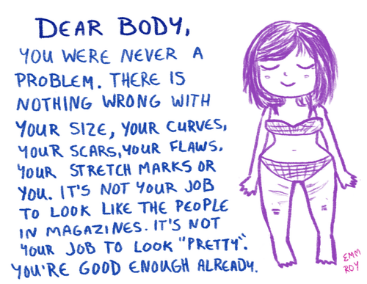
When you think about your favorite actors, actresses, singers, models, etc., how many plus-sized men and women come to mind? Chances are you can only think of a couple, or if you are like most people, probably none. The way plus-sized people, women especially, are portrayed in media is not the same as thinner-figured individuals are portrayed. Because of the way bigger women are shown in the media, women have begun to believe the term “plus-sized” or “fat” is bad. Thanks to the body positivity movement, however, we are showing women of all shapes and sizes that it is okay to love your body regardless of your size.


The film industry rarely casts full-figured women in lead roles, and if they do, she serves as comedic relief; take, for example, Fat Amy. Other times she is hidden amongst the crowd. We also see them portrayed as the “ugly duckling” who usually overcomes obstacles caused because of her weight, and gets the man in the end, like in the movies Hairspray and Just Wright. Rarely is there a movie where a plus-sized woman’s weight isn’t the source of her lack of confidence, depression, or undesirability. Why can’t we cast more big women in leading roles? Are we shaping a negative belief in our society?

It is no doubt that the media sculpts the way we think about everyday life. Not only do movies outline the way adult women think, but it changes the way young girls see themselves. If a young girl is watching her favorite movies or TV shows and all of her favorite characters are tall and thin, the girl will begin to wonder why her body does not look that way. The fix is as simple as casting plus-sized girls to stop insecurity at a young age.

As an attempt to help this cause, women all over the world have started the body positivity movement. This movement acts to encourage girls to love their bodies no matter what color, how big,  how rough or scarred, or how different. The body positivity movement has brought women of all backgrounds and cultures together to grow and work as a team rather than against each other. Famous women have spoken on the topic, such as Demi Lovato, Mary Lambert, Rihanna, and Rebel Wilson, all saying that this movement has helped them cope with being a larger woman in media and is helping their sisters get the recognition they deserve.


Although body positivity isn’t supported by all, it has helped thousands of young women accept their bodies. As the movement continues to grow, the way plus-sized men and women are viewed will hopefully change. No longer will “fat” or “plus-sized” be an insult, and no longer will only “skinny” people take the leads in the media. The future of film should heavily rely on the reflection of reality. Plus-sized women embody the hues of womanhood and should be appreciated.


Visit here for more articles on body positivity!

Thursday, May 5, 2016

Social Acceptance: More than Just Labels by Kaley Beck


One of the most important things that is easily forgotten today is social acceptance. There are thousands of different types of people in the world, and yet we tend to find the ones that fit a certain criteria most appealing. This is shown in nearly every type of pop culture out there: movies, books, music videos, magazine covers, etc. The question is why, in today's times, where we are more culturally diverse than ever, do we continue to separate each person from one another? Why do we continue to put people into diminutive boxes with enormous labels over them to limit the person's depth and character?


We see this every day.  The cheerleader becomes simply the cheerleader, the member of the school band is labeled as just that, and even those who do not belong to a category get put into one. In movies, the popular football player goes for the shy girl. While this creates a misconception that producers are defying stereotypes, it is actually doing the exact opposite. Viewers have already put these characters into their labeled boxes, which is why we love it when the couple ends up together. This applies to gender stereotypes as well, even in things as small and insignificant as colors and hair styles. Most of the time in movies and books, the females are thin with long hair and typical beauty features. These are the stories that appeal the most to viewers because they are seen as ideal. Whether we notice we are doing it or not, we are playing into the stereotypes and labels.


Imagine this: A couple falls in love, but plot twist: they are just an ordinary couple. This could be a boy and a girl, a girl and a girl, or a boy and a boy, but it doesn't matter. The author/movie producer chooses to focus on their personalities, stories, and connection as opposed to the stereotypes that they are somehow (but not really) defying. Instead of focusing on labels, the book/movie completely ignores them, making the characters into people with more depth than one or two labels.
This could cause either nothing or everything, but both would be extraordinary. The reader/viewer could possibly not react at all, and maybe even feel as if they have wasted a fraction of their life watching/reading.  Or another possibility: they could  relate to the beauty of the piece simply because they were able to experience a genuine story. In this scenario, you learn to love the characters, and not because they defied the stereotypes that they were introduced as. You learn to love them for their humor, kindness, and wit. You are able to look at them as more than a label and as an authentic human being. If more pop culture did this, then maybe in real life people could adjust to seeing each other as human beings as well. Insignificant characteristics such as sexual orientation, appearance, and gender roles could become... well, insignificant as they should be.


My personal favorite examples of pop culture that overlook labels are books written by Ellen Hopkins. Hopkins writes in the form of free-verse poetry; the books revolve around controversial issues of realistic teenagers, which are utterly and completely beautiful. Many of her books show several points of view from a wide spectrum of characters. Examples of these are Impulse, Perfect Tricks, Tilt, and Identical. Within these novels, readers hear the stories of people of different sexual orientations, social groups, races, religions, upbringings, and personalities. In each book, the characters have immense depth, showing them as truly human. Despite their uniqueness, one thing that each character has in common is that they all carry struggles and baggage, just as every person does. That is one of the only aspects of life that every human being can relate to. In these books, the characters always intertwine into each other's stories, showing their humanity in comparison. The teenager struggling with her sexuality and identity is shown with equal significance to the female pageant queen. The "perfect," sporty boy struggles just as much as the girl with a broken family who self harms. The girl who comes from a conservative, religious family has a hidden story just like the girl with the drug addiction. Despite their differences, the characters are all represented as equally important, and the reader grows to love and connect with each of their stories. The reader has the view that each character is more than the stereotypes that tear them down; this is achieved because Hopkins writes in such a way that allows the reader to forget the stereotype all-together, rather than drawing attention to it.


Diversity is what makes up humanity, and our society would be much less divided if we stopped dividing it by things that do not define a person. We are each so much more than one single adjective. If we started accepting our differences rather than pointing them out, people would have freedom to be themselves without fear of feeling persecuted and unaccepted. If pop culture did not focus so much on peoples' differences and focused more on their positive qualities, people could have the ability to do this as well. Ultimately, the world would be a better place if we could all accept that our differences are what collectively make us human beings; we should start using words of sensitivity that do not degrade each other of worth or depth.


  For a similar book review about Ellen Hopkins' IMPULSE, go here.


Monday, April 25, 2016

MiNd Of HiS oWn by Maddy Arthur

March 2015 was one of the worst months for the fans of One Direction, when Zayn Malik decided he wasn’t exactly boy band material. After going through four tours, four albums, multiple awards shows, and almost five years in a band with four other boys he claimed to be “his best friends,” Zayn called it quits and went in his own direction. Zayn was always viewed as the “quiet one” of the group and never expressed his opinion or true self until now. 


Zayn signing his new record deal with RCA Records. The beginning of his journey towards becoming a single artist.
After leaving the boys in late July, he signed onto RCA Records, a music producing company. A few weeks after, his fiancé, Perrie Edwards, dumped him over text. Not appearing too heartbroken, he started to come out of his shell by posting shirtless pictures and selfies on an almost daily basis. Ready to express himself to the world, he began recording music with Naughty Boy, which caused "twitter beef" between Zayn, Louis Tomlinson, and Naughty Boy. After that incident, he found the sound he wanted to share with the world: R&B.


On January 21, 2016, Zayn dropped his new single, PILLOWTALK. Alongside dropping new music, he dropped his last name. Similar to single artists such as Beyoncé, Prince, and Drake, he only goes by "Zayn." He left his audience speechless and in love. Girls who vowed never to listen to his music found themselves singing along to the radio whenever it played. Fans around the globe were waiting for him to release a new music video and more music. And that is just what he did.
 
Zayn’s girlfriend, Gigi Hadid, in the music video, Pillowtalk.
https://www.youtube.com/watch?v=C_3d6GntKbk
Seven days later Zayn released his music video for PILLOWTALK. His video visually revealed the path he wanted to take. The video showed the adult, dark, and sexual side of Zayn. He represented his version of art through nudity, crying blood, and his new girlfriend, Gigi Hadid. It was his art that majorly impacted the breakout of his album, “bOrDeRz.” Zayn even claimed in One Direction: This is Us in 2013 that he bought his own house because his mother wouldn’t let him paint on the walls. With four other boys trying to make their image, he was oppressed and not able to show people what he stood for. Zayn also states that he left One Direction because it was no longer was about being number one for him, but reaching out to his fans.


Zayn’s album MIND OF MINE released on March 25, 2016.


Not long after Pillowtalk was released, Zayn showed us an adorable throwback with his current tattoos as the album cover of MIND OF MINE. In this album, he revealed 18 R&B/Pop song, including 6 explicit songs- One Direction has never released an explicit song before. Most of the songs on the album have a smooth and slow flow to them, capturing the essence of R&B. A few of his song are upbeat and fast, making them lean more towards the pop side of music. He told Fader magazine One Direction music wasn’t his kind of music when he said, “That’s not music that I would listen to. Would you listen to One Direction, sat at a party with your girl? I wouldn’t. To me, that’s not an insult, that’s me as a 22-year-old man. As much as I was in that band, and I loved everything that we did, that’s not music that I would listen to. I don’t think that’s an offensive statement to make. That’s just not who I am.” He said it himself; that wasn’t what he was, wanted to be, or the image he wanted to create. Zayn has shown his true self through MIND OF MINE and has become a man. Each day he receives more and more support from fans that learn his story and his reason for leaving. He is no longer a boy, he is ZAYN.


 For more about Zayn visit http://www.thefader.com/2015/11/17/zayn-malik-fader-cover-story-interview-solo-album-one-direction